Air porosity in die casting is the most common cause of rejected aluminum castings — and the leading reason sealed housings fail leak tests. When machining exposes subsurface gas pockets, or pressure testing reveals micro-leak paths, both scrap rates and customer complaints rise sharply. This article explains the root causes of air porosity in die casting and presents 5 engineering solutions validated in production, with reference to ASTM E505, ISO 8062-3, and NADCA recommended practices.
Porosity Types and Root Causes at a Glance
| Porosity Type | Root Cause | Typical Location | Primary Solution |
|---|---|---|---|
| Gas (air) porosity | Turbulent fill, air entrapment, cold flow | Under gates, last-filled areas | Vacuum assist, optimized gating, overflow wells |
| Hydrogen porosity | Undegassed melt, high humidity | Uniformly distributed | Rotary degassing (density index < 1.5%) |
| Shrinkage porosity | Improper feeding, hot spots | Thick sections, transitions | Intensification pressure, cooling control |
| Surface blistering | Gas expansion during heat treatment | Near-surface | Vacuum HPDC or switch to A356/LPDC |
1. Root Cause: Turbulent Fill and Air Entrapment
The dominant cause of air porosity in die casting is turbulent mold filling. In HPDC, melt velocities of 30–60 m/s at the gate can fold air into the metal stream, creating gas pockets that remain in the casting. Slow-shot phase control, correct gate velocity (typically 20–40 m/s for aluminum), and overflow well placement reduce air entrapment significantly. Flow simulation per NADCA gating guidelines should be used at the tooling design stage to validate the filling pattern before steel is cut.
Porosity in cast metals is evaluated on production parts using X-ray inspection per ASTM E505 reference radiographs, which define acceptance levels for gas and shrinkage porosity. Specify the ASTM E505 class in your drawing — this removes subjectivity from porosity disputes during first-article inspection.
2. Solution: Vacuum-Assisted HPDC for Leak-Tight Housings
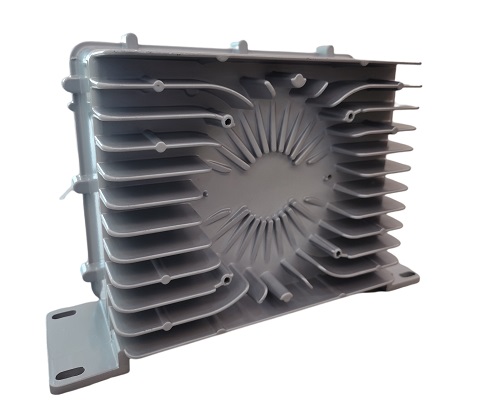
Vacuum-assisted high-pressure die casting draws the cavity to 30–100 mbar before injection, removing the air that would otherwise be entrapped. This is the most effective single countermeasure for air porosity in die casting of leak-tight components such as transmission housings, EV motor housings, and fluid manifolds. Vacuum systems also enable in-house heat treatment of HPDC parts in many cases, because the gas content that causes blistering is removed at the source.
3. Solution: Melt Quality Control with Rotary Degassing
Hydrogen picked up from humid air or wet charge material forms the second major source of gas porosity. Rotary degassing with argon or nitrogen reduces hydrogen content to a density index below 1.5%, verified with a reduced-pressure test (RPT). Confirm during supplier audits that degassing is performed with logged parameters — rotor speed, gas flow, and duration — rather than manual fluxing, which is inconsistent and often insufficient for air porosity in die casting control.
4. Solution: Intensification Pressure and Thermal Control
Shrinkage porosity forms when solidification contraction is not compensated by liquid feed. Raising intensification pressure (typically 300–700 bar for aluminum HPDC) and controlling die temperature with conformal cooling compresses and feeds the casting during solidification, reducing shrinkage voids. Because air porosity in die casting and shrinkage porosity often coexist, the process window must balance fill speed, pressure, and thermal gradient — verified through design of experiments during process development.
5. Solution: Vacuum Impregnation as a Salvage Process
For micro-porosity that leaks under pressure, vacuum impregnation with methacrylate or sodium silicate sealant is a proven salvage process. Specify in the RFQ whether impregnation is permitted, which sealant class applies, and the re-test criteria after impregnation. Impregnation does not eliminate the root cause — it contains the defect — so it should be combined with the process solutions above rather than relied on as the primary fix for air porosity in die casting.
FAQ for Procurement & Production Technology Teams
Q1: What porosity acceptance level should I specify for die cast housings?
A: Reference ASTM E505 radiograph classes for gas and shrinkage porosity, and define the acceptance class (e.g., Class 2) on your drawing. For leak-tight applications, add a functional leak test (e.g., 0.2 MPa air, < 1 cc/min) — the functional test is ultimately what protects your assembly line from air porosity in die casting rejects.
Q2: Can HPDC parts with porosity be heat treated?
A: Conventional HPDC parts contain entrapped air that blisters during T6 treatment. Options are vacuum-assisted HPDC (low gas content), or switching the process to A356 with LPDC/GDC, which allows standard T6 without blistering. Specify the requirement up front — it changes the process and tooling entirely.
Q3: How do I audit a foundry’s porosity control capability?
A: Check four things: rotary degassing logs with density index data, X-ray inspection records per ASTM E505, the process window documentation (fill speed, intensification pressure), and leak test data from serial production. Ask to see 12 months of internal scrap data broken down by air porosity in die casting type — this separates suppliers who control the defect from those who merely sort it.
Q4: How does X-Diecasting Tech help with porosity and leakage problems?
A: With 20 years of die casting and mold engineering experience, our founder-led team performs gating and filling analysis, specifies vacuum and degassing systems, and supports leak test design with our production partners. We help global buyers define acceptance criteria and verify supplier process capability — contact our engineering team to discuss your casting program.
Controlling air porosity in die casting requires attacking every source — turbulent fill, hydrogen pickup, shrinkage, and subsurface gas — with a combination of design simulation, vacuum assist, melt treatment, and process control. When acceptance criteria are anchored to ASTM E505 and ISO 8062-3, and leak requirements are stated functionally, suppliers can quote accurately and deliver leak-tight parts consistently. For a porosity risk review of your part, contact our engineering team.
About X-Diecasting Tech: Founded by an engineer with 20 years of die casting and mold design experience, X-Diecasting Tech provides aluminum die casting components, tooling, and process engineering support to global OEMs and tier suppliers. Our team applies ISO 9001-aligned quality systems and ASTM / DIN / ISO standards across every program we support.